
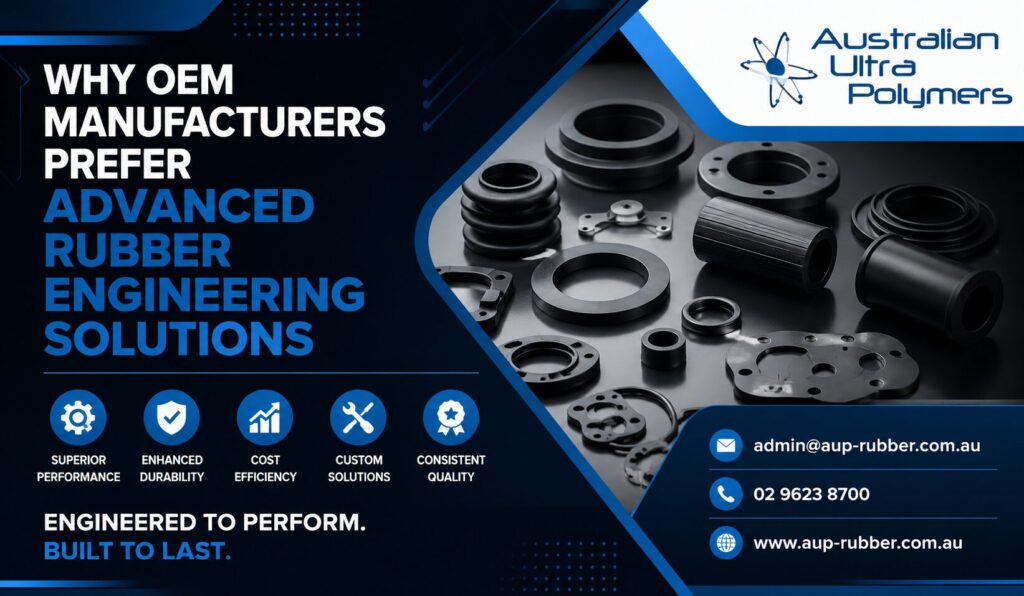
Original equipment manufacturers (OEMs) operate in highly competitive industries where product quality, durability, and performance directly impact business success. From automotive and mining to construction, agriculture, transport, and heavy industrial manufacturing, OEMs require components that consistently perform under pressure. This is why many businesses are turning to advanced rubber engineering solutions to improve reliability, reduce maintenance costs, and enhance long-term operational efficiency.
Modern industrial applications demand more than standard materials. OEM manufacturers now seek customised rubber moulding, precision-engineered formulations, and advanced manufacturing capabilities that align with specific operational requirements. Companies that specialise in high-performance rubber manufacturing have become essential partners in helping OEMs meet strict industry standards while improving product longevity.
Among Australia’s trusted industrial rubber specialists, Australian Ultra Polymers (AUP Rubber) has established itself as a reliable provider of engineered rubber solutions for demanding industrial environments.
 Rubber calendering plays a major role in applications requiring:
The Growing Demand for Advanced Rubber Engineering
Industries today face increasingly harsh operating conditions. Components are exposed to heat, chemicals, abrasion, pressure, UV exposure, oils, and fluctuating environmental conditions. Standard rubber materials often fail prematurely when used in specialised industrial environments. Advanced rubber engineering solves these challenges through customised formulations and precision manufacturing processes. By combining expert rubber compounding, specialised material selection, and accurate production techniques, OEMs can achieve better performance, compliance, and durability. This is particularly important for industries such as:- Automotive manufacturing
- Mining and mineral processing
- Construction equipment manufacturing
- Food processing machinery
- Agricultural equipment
- Industrial sealing systems
- Transportation and infrastructure
Why Rubber Moulding Matters in OEM Manufacturing
One of the key processes driving industrial innovation is rubber moulding. Precision moulded rubber components are used in seals, gaskets, vibration dampeners, rollers, hoses, protective linings, and specialised industrial parts. Well-designed moulded rubber products provide several important advantages:Enhanced Product Durability
OEM products must withstand continuous operational stress. High-quality rubber moulding ensures components maintain flexibility, elasticity, and structural integrity even in extreme conditions. Custom moulded parts reduce cracking, deformation, and material fatigue, helping OEM manufacturers minimise warranty claims and downtime.Precise Fit and Performance
Advanced moulding technology enables manufacturers to create highly accurate components tailored to exact product specifications. This improves sealing performance, reduces mechanical wear, and enhances operational efficiency. For OEMs, precision directly impacts final product quality and customer satisfaction.Reduced Maintenance Costs
Industries increasingly focus on reducing operational expenses. High-performance moulded rubber products last longer and require fewer replacements, significantly lowering maintenance costs over time.Industry-Specific Solutions
Different industries require unique material characteristics. For example:- Automotive applications require heat and oil resistance
- Mining applications require abrasion resistance
- Food-grade applications require compliance and hygiene standards
- Outdoor infrastructure applications require UV and weather resistance
The Critical Role of Rubber Compounding
The foundation of high-performance industrial rubber lies in effective rubber compounding. This process involves blending raw elastomers with additives, fillers, curing agents, and performance-enhancing materials to create a compound with specific characteristics. OEM manufacturers rely heavily on custom compounds because no single rubber formulation suits every industrial application.Benefits of Custom Rubber Compounding
Custom compounding provides several operational advantages:Improved Mechanical Strength
Carefully engineered compounds increase tensile strength, tear resistance, and elasticity, improving component lifespan.Superior Chemical Resistance
Industries using oils, fuels, solvents, or corrosive substances require compounds that resist chemical degradation.Enhanced Temperature Stability
Advanced compounds can withstand both high-temperature and low-temperature environments without losing performance.Better Compliance and Safety
OEMs often require materials that comply with industry standards and regulatory requirements. Professionally developed compounds ensure compliance while maintaining performance. At AUP Rubber, advanced rubber compounding capabilities support a wide range of industries across Australia. The company specialises in custom formulations designed to meet demanding industrial specifications. Their expertise covers Natural Rubber, EPDM, Nitrile, Viton, HNBR, Hypalon, Neoprene, Butyl, and other industrial elastomers.How Rubber Calendering Improves Industrial Performance
Another important manufacturing process OEMs value is rubber calendering. This process involves passing rubber through precision rollers to create sheets, strips, or coated materials with highly controlled thickness and surface consistency. Rubber calendering plays a major role in applications requiring:
- Industrial sheeting
- Conveyor systems
- Protective linings
- Sealing materials
- Laminated rubber products
- Adhesive-backed rubber solutions
Advantages of Advanced Rubber Calendering
Consistent Material Thickness
Precision calendering ensures uniform material thickness, which is critical for performance-sensitive industrial products.Improved Surface Quality
Smooth, consistent surfaces improve sealing performance and product reliability.Enhanced Production Efficiency
Calendered rubber products are easier to integrate into automated manufacturing processes, improving OEM production efficiency.Better Material Control
Advanced calendering enables greater control over material properties, improving overall product consistency. AUP Rubber operates advanced rubber calendering systems that help ensure consistent industrial rubber production across a variety of applications. Their ISO-certified manufacturing approach helps OEMs maintain quality assurance standards throughout the supply chain.Why OEMs Choose Experienced Rubber Manufacturing Partners
OEM manufacturers do not simply purchase materials, they seek long-term manufacturing partners capable of supporting product innovation and operational reliability. Several factors influence supplier selection.Technical Expertise
Experienced rubber manufacturers understand material science, application engineering, and industry-specific performance requirements. This expertise helps OEMs select the most suitable compounds and manufacturing processes. AUP Rubber offers in-house technical support and custom formulation development to help clients achieve the right performance outcomes for their applications. Production Flexibility OEM production schedules can vary significantly. Flexible manufacturing capabilities allow suppliers to support both small development runs and large-scale production. AUP Rubber supports everything from small sample batches to multi-tonne production volumes, giving OEMs greater supply chain flexibility.Consistent Quality Assurance
Industrial manufacturers require consistency across every production batch. ISO-certified systems help ensure repeatable quality and reliable product performance.Faster Product Development
OEMs often face pressure to launch products quickly. Suppliers with advanced manufacturing infrastructure and responsive technical teams can accelerate development timelines.Australian Manufacturing Reliability
Local manufacturing support offers advantages including:- Faster delivery times
- Improved communication
- Better quality oversight
- Reduced supply chain risks
- Ongoing technical collaboration
Industries Benefiting from Advanced Rubber Engineering
Modern OEM industries increasingly rely on engineered rubber products for critical applications.Automotive Industry
Automotive OEMs use precision rubber components in sealing systems, vibration control, fuel handling, and weatherproofing applications.Mining and Heavy Industry
Mining environments require highly durable rubber materials resistant to abrasion, chemicals, and heavy mechanical stress.Construction Equipment
Construction machinery depends on reliable rubber components that can perform under continuous exposure to harsh environmental conditions.Agriculture
Agricultural equipment manufacturers require weather-resistant rubber products capable of handling extreme outdoor exposure.Manufacturing and Processing
Industrial processing systems require specialised rubber solutions that maintain safety, efficiency, and operational reliability.The Future of Rubber Engineering for OEMs
As industrial technology evolves, OEM manufacturers will continue demanding smarter, more durable, and more efficient materials. Advanced rubber engineering will play an increasingly important role in:- Improving sustainability
- Enhancing equipment lifespan
- Reducing maintenance costs
- Supporting automation
- Increasing product safety
- Meeting environmental regulations
Why AUP Rubber Stands Out
OEM manufacturers across Australia choose AUP Rubber because of its commitment to quality, technical expertise, and customer-focused manufacturing solutions. Key advantages include:- Over 25 years of industry experience
- Advanced rubber compounding capabilities
- Precision rubber moulding solutions
- High-quality rubber calendering services
- ISO-certified manufacturing processes
- Custom formulation expertise
- Flexible production capacity
- Australian-owned manufacturing reliability